Article Overview: This article helps CTOs, technical architects, and procurement teams evaluate spring return (single-acting) and double acting pneumatic actuators for quarter-turn valve automation. We examine operating principles, fail-safe behavior, air consumption, sizing implications, and common application contexts. The goal is to provide an objective decision framework that aligns with your process safety, reliability, and cost requirements.
How Do Spring Return and Double Acting Actuators Differ in Operation?
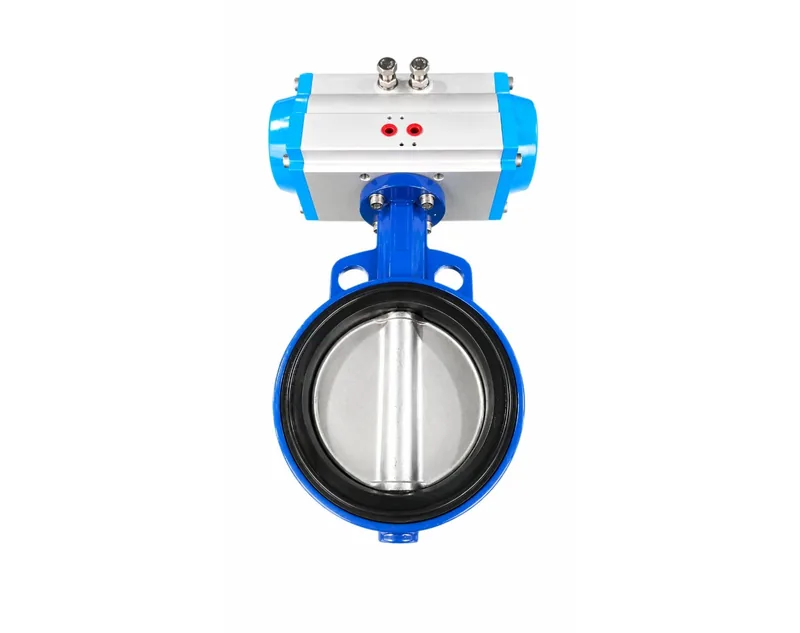
Spring return actuators, also known as single-acting actuators, use a compressed spring to return the valve to a predetermined fail position (open or closed) when air supply is lost. Double acting actuators require air pressure to move the valve in both directions—no spring is involved. This fundamental difference drives all other design trade-offs.
Operational Principle
Option A (Spring Return): Air pressure compresses the spring to stroke the actuator. When air is exhausted, the spring expands to return the valve to its fail-safe position. The spring is always engaged, requiring additional torque to overcome its force during normal operation.
Option B (Double Acting): Air pressure on one side of the piston drives the valve open, and pressure on the opposite side drives it closed. No spring means no preload—full supply pressure is available for both strokes, but there is no inherent fail action without external backup.
Buyer note: Choose spring return when your process demands a known valve position on loss of air (e.g., emergency shutdown). Choose double acting when fail-safe can be managed by other means or when the valve is required to hold position on loss of air.
Key differences in operation also include:
- Fail behavior: Spring return provides a predefined fail position (fail-open or fail-close). Double acting holds position on loss of air unless fitted with an external locking or auxiliary system.
- Air supply: Spring return uses a single air line (dual-port actuators often use two ports but one is always connected to the spring chamber vent). Double acting requires two air lines—one for open, one for close.
- Torque output: In spring return actuators, the available torque decreases as the spring compresses (end-of-stroke torque dip). Double acting delivers more consistent torque throughout the stroke.
What Are the Air Consumption and Sizing Trade-offs?
Air consumption directly impacts compressor sizing and operating cost. In spring return actuators, only one stroke is powered by air; the return stroke is driven by the spring. In double acting actuators, both strokes consume compressed air. However, the spring chamber in spring return actuators adds dead volume, so total air consumption per cycle may be comparable or even higher depending on actuator design.
Phase 1: Quantify Cycle Air Demand
For spring return: measure volume of the pressure chamber during the powered stroke only. Multiply by stroke length and cycle frequency. Double acting: add both stroke volumes. Example scenario: A rack-and-pinion actuator in a valve cycling 100 times per hour might consume 2–3 SCFM more in double acting configuration, but that varies by bore size and spring rating.
Phase 2: Sizing for Torque Requirements
Spring return actuators require a higher starting torque because the spring must be compressed simultaneously. Use a torque safety factor of 1.25–1.5 for spring return vs. 1.2–1.3 for double acting (based on common industry practice—always validate against your valve manufacturer's specification). Double acting sizing is simpler: ensure supply pressure provides enough torque at both stroke ends.
- Spring fatigue: Over time, springs can weaken, reducing return torque. Factor this into maintenance intervals.
- Air quality: Both types benefit from clean, dry air, but spring return actuators with small internal passages are more sensitive to contaminants.
When Should You Choose Spring Return vs Double Acting?
The choice depends on process safety requirements, system reliability targets, and lifecycle cost. Below are decision points for common applications.
Application Fit: Safety-Critical Services
Option A (Spring Return): Preferred for emergency shutdown (ESD), blowdown, and fire-safe valves where fail-closed or fail-open is mandatory. Can be integrated into SIL-rated loops with proper proof testing. Example: Isolation valves on a feed line.
Option B (Double Acting): Suitable for modulating control, block-and-bleed systems, or processes where a locked position on air loss is acceptable. May require a separate solenoid valve or lock-up system to achieve fail-safe.
Buyer note: If your safety instrumented system demands spring return, ensure the actuator's spring range matches the valve torque at the worst-case process condition.
Use Case: High Cycle / Modulating Duty
Option A (Spring Return): Not recommended for high-frequency cycling (e.g., >30 cycles per hour) because the spring can overheat and fatigue prematurely. Also, the higher operating force can accelerate seal wear.
Option B (Double Acting): Better suited for continuous modulation because torque is more linear and spring wear is absent. Often used in fast-acting blowdown valves or positioner-controlled applications.
Buyer note: For modulating service, double acting actuators combined with a smart positioner and fail-safe lock-up valve can provide both performance and safety.
Common Misconceptions and Procurement Pitfalls
Even experienced buyers can overlook key details. Below are frequent mistakes and how to avoid them.
- Assuming spring return is always safer: A spring can fail due to corrosion, fatigue, or incorrect sizing. Proof testing is essential. Double acting actuators with an external lock-up valve can achieve comparable safety integrity.
- Ignoring spring set selection: Spring range must account for minimum supply pressure. A spring rated for 3–7 bar may not fully stroke if the supply is marginal. Always verify the actuator's spring cut-in and cut-out pressures.
- Overlooking actuator conversion possibilities: Many rack-and-pinion pneumatic actuators are designed to be converted between double acting and spring return by adding or removing a spring cartridge. This flexibility can simplify spare parts inventory but requires proper re-testing. See the spring return vs double acting actuator specifications on our pneumatic actuator product page for conversion details.
- Neglecting ISO 5211 mounting dimensions: Both actuator types should comply with ISO 5211 for direct valve mounting. Confirm the actuator's mounting bolt pattern and drive type before ordering.
FAQ
Can a double acting pneumatic actuator be converted to spring return?
Yes, many pneumatic actuators, especially rack-and-pinion designs, allow field conversion by installing a spring cartridge assembly. However, the actuator housing must be rated for spring force, and the conversion may change the torque output. Always consult the manufacturer's conversion kit specifications.
Do spring return actuators consume more air than double acting?
Not always. While double acting uses air for both strokes, spring return actuators have a larger internal volume due to the spring chamber. Total air consumption per cycle can be similar or slightly higher for spring return, depending on the spring pack size. Measure your specific actuator's swept volume to compare.
What torque safety factor should I use for spring return vs double acting?
Industry guidelines typically recommend 1.25–1.5 for spring return (to account for spring hysteresis and friction) and 1.2–1.3 for double acting. Always confirm with your valve and actuator supplier, especially for safety-critical applications.
Are spring return actuators more expensive than double acting?
Initial purchase price is often higher for spring return due to the spring cartridge and larger housing. However, if a fail-safe mechanism is required, the total system cost (including external lock-up valves for double acting) may favor spring return. Evaluate total lifecycle cost including maintenance.
Conclusion: Making the Right Selection
The decision between a spring return and a double acting actuator hinges on your process safety philosophy, air supply reliability, and valve torque profile. Spring return actuators deliver inherent fail-safety but impose higher torque demands and maintenance considerations. Double acting actuators offer consistent torque and lower cyclic wear but require external means to achieve a fail state. By mapping your operating conditions against the criteria outlined above—fail position, air consumption, cycle frequency, and safety integrity—you can make an informed choice. For further guidance on sizing and configuration, explore our pneumatic actuator product line or contact an application engineer to review your specific valve specifications.
Related site pages: spring return vs double acting actuator, Home.