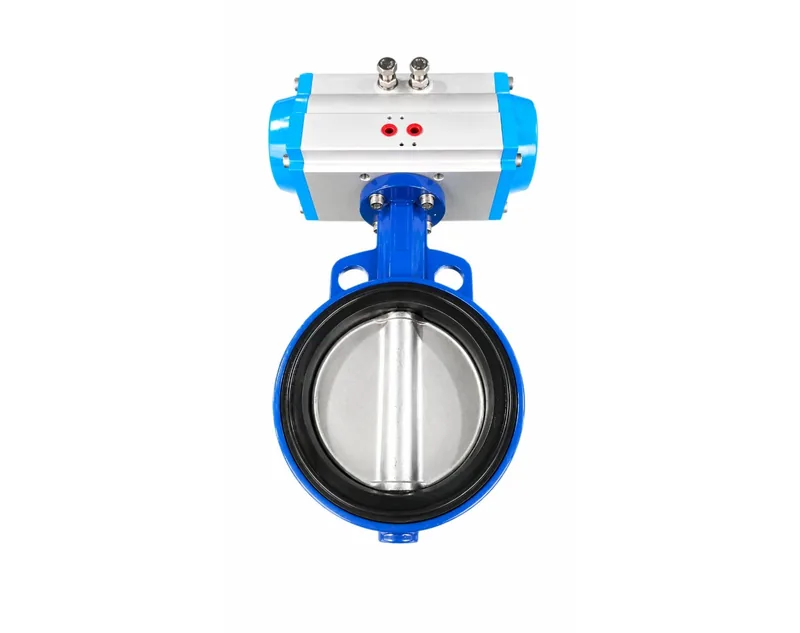
Article Overview: This article provides an objective comparison of rack and pinion vs scotch yoke pneumatic actuator designs. It focuses on torque characteristics, cycle speed, envelope size, and typical valve applications to help technical buyers select the appropriate quarter-turn actuator for their process.
What Are the Core Differences Between Rack and Pinion and Scotch Yoke Actuators?
Both rack and pinion and scotch yoke mechanisms convert linear piston motion into rotary output for quarter-turn valves (ball, butterfly, plug). However, their internal geometry creates distinct torque output profiles that influence actuator selection.
Rack and pinion design: Two pistons with rack teeth engage a central pinion gear. As pistons move outward under air pressure, the pinion rotates. This yields a relatively constant torque output throughout the 0–90° stroke. It is symmetric in double-acting mode; spring-return (single-acting) uses springs on one or both pistons to provide fail-safe action.
Scotch yoke design: A sliding yoke mechanism connects a single piston to a rotating pin. The yoke slot profile creates a variable torque output: low torque at the start of stroke, increasing to maximum at the midpoint, then decreasing again. This non-linear profile can be tailored (e.g., modified yoke slot) to match the break-open torque of a high-pressure valve.
Key structural difference: Rack and pinion actuators are generally compact and lightweight for a given torque range. Scotch yoke actuators are larger and heavier but can generate very high torques with a relatively small cylinder bore, making them suitable for large ball valves or high-pressure services.
Torque Profile Comparison
Option A (Rack and Pinion): Torque output is nearly flat across the rotation, with a slight increase at the end of stroke due to gear geometry. Provides maximum torque at the closed position, which can exceed the valve's seating torque requirement.
Option B (Scotch Yoke): Torque output peaks at mid-stroke, matching the typical break torque profile of ball and butterfly valves. This allows a smaller actuator to provide the required breakout torque, reducing size and cost for high-torque applications.
Buyer note: If your valve requires a high breakout torque followed by low running torque, a scotch yoke actuator may be more efficient. For constant torque requirements (e.g., a modulating butterfly valve), rack and pinion may offer simpler sizing.
How Do Torque Profiles Affect Valve Selection?
The torque curve of the actuator must exceed the valve torque requirement at every rotation angle. This matching process is essential for reliable operation and avoiding valve damage.
- Ball valves (especially trunnion-mounted): Require high breakout torque due to seat friction at rest. Scotch yoke actuators often provide a better fit because their peak torque coincides with the breakaway point.
- Butterfly valves: Moderate torque increase near closure; rack and pinion actuators are commonly specified for smaller sizes (up to 12") where constant torque is adequate.
- Plug valves: Often require high seating and unseating torque; scotch yoke actuators are preferred for larger or higher-pressure plug valves.
Technical buyers should obtain a valve torque curve from the valve manufacturer and overlay it with the actuator's output torque curve at the available supply pressure (typically 4–8 bar). Many actuator datasheets (e.g., JIMAI quarter-turn rack and pinion series) provide torque tables at standard pressures.
Cycling Speed and Frequency
Option A (Rack and Pinion): Generally faster cycling due to lower mass of moving parts and dual-piston design. Suitable for quick-opening/closing services (e.g., emergency shutdown valves requiring response under 1 second). Rack and pinion actuators can cycle 500,000+ times with proper lubrication.
Option B (Scotch Yoke): Slower cycle times due to larger stroke and heavier components. However, the scotch yoke design can handle high cycle counts in heavy-duty applications (e.g., offshore choke valves) if maintained with hardened yoke pins and lubrication.
Buyer note: For high-speed cycling (more than 10 cycles per minute), rack and pinion is typically preferred. For slow, high-torque operations with infrequent cycling, scotch yoke offers durability.
Comparison of Key Performance Criteria
The following table summarizes specification ranges for typical rack and pinion vs scotch yoke pneumatic actuators. Exact values vary by manufacturer and model.
| Criterion | Rack and Pinion | Scotch Yoke |
|---|---|---|
| Torque range (Nm) | 5 – 10,000 (typical JIMAI JAT series) | 100 – 500,000+ (JIMAI HXY series) |
| Operating pressure | 2 – 10 bar | 3 – 12 bar |
| Rotation angle | 0–90°, some up to 120° | 0–90° (standard), 0–180° available |
| Weight per torque | Low to medium | Medium to high |
| Cycle speed (0–90° at 6 bar) | 0.5 – 3 seconds | 2 – 10 seconds |
| Typical valve types | Butterfly, ball, plug (small to medium) | Ball, plug, high-performance butterfly (large) |
| Mounting standard | ISO 5211 (direct mount) | ISO 5211 (via bracket often) |
| ATEX / SIL suitability | Yes (with appropriate options) | Yes (with appropriate options) |
When evaluating specifications, consider the actual torque requirement at the specific working pressure. A scotch yoke actuator may be oversized if the valve requires low torque, resulting in unnecessary capital expense.
Application Scenarios: Which Actuator Fits Your Process?
Selecting between rack and pinion vs scotch yoke pneumatic actuator depends on the service conditions and valve characteristics. Below are common industrial scenarios with recommended actuator types.
Step 1: Assess Valve Type and Size
Ball valves above 6", especially trunnion-mounted, will likely benefit from a scotch yoke actuator's torque profile. Butterfly valves up to 12" are well-served by rack and pinion actuators. For larger butterfly valves (14"+), evaluate scotch yoke options.
Step 2: Determine Cycle Speed Requirements
If your process requires emergency shutdown (ESD) valve closure within 2 seconds, rack and pinion is the typical choice. For slow-acting choke valves or batch processes, scotch yoke provides adequate speed and higher torque.
Step 3: Evaluate Space and Weight Constraints
Rack and pinion actuators have a smaller footprint, making them suitable for skid-mounted packages and valve manifolds. Scotch yoke actuators require more mounting space and structural support.
- Chemical processing: Frequent use of butterfly valves with modulating control loops → rack and pinion often preferred.
- Oil and gas (pipelines, wellheads): Large ball valves with high breakout torque → scotch yoke is standard.
- Water treatment: Medium-size butterfly and plug valves → both types used; choose based on torque and cycle frequency.
- Power generation: Steam isolation with large ball/butterfly valves → scotch yoke for high torque, rack and pinion for auxiliary systems.
FAQ
Which type of pneumatic actuator is more compact?
Rack and pinion actuators are generally more compact and lighter than scotch yoke actuators for the same torque range up to about 10,000 Nm. Above that, scotch yoke designs become more space-efficient relative to torque output.
Can rack and pinion actuators be used for high-torque applications?
Yes, but you may need a larger actuator (more cylinder volume) to generate the same breakout torque as a smaller scotch yoke due to the torque profile mismatch. For torques above 10,000 Nm, scotch yoke is often the practical choice.
How does supply pressure affect the choice?
Both types operate on compressed air (typically 4–8 bar). At higher pressures (8–12 bar), scotch yoke actuators can deliver very high torques without increasing cylinder bore size. For lower pressure plants, rack and pinion may offer better torque consistency.
What maintenance is required for each type?
Rack and pinion actuators require periodic lubrication of the gear and piston seals. Scotch yoke actuators need inspection of the yoke pin and bushing due to sliding contact. Both benefit from clean, dry air supply to extend seal life.
Which actuator is better for modulating service?
Rack and pinion actuators are more common for modulating (control) service due to smoother torque output and faster response. Some scotch yoke designs with modified yoke slots can also be used for modulating, but they are less widely applied.
Conclusion
The decision between rack and pinion vs scotch yoke pneumatic actuator hinges on torque profile alignment, cycle speed, envelope, and valve size. For low to medium torque applications with frequent cycling, a rack and pinion actuator offers compactness and speed. For high breakout torque infrequent service, a scotch yoke actuator provides efficient torque matching and durability.
Technical buyers should gather the valve's torque curve, required response time, and available space before selecting. For a detailed selection recommendation tailored to your valve specification, consult a qualified actuator supplier such as JIMAI, who can provide torque tables and certified performance data for both rack and pinion and scotch yoke designs.
Related site pages: rack and pinion vs scotch yoke pneumatic actuator, Home.