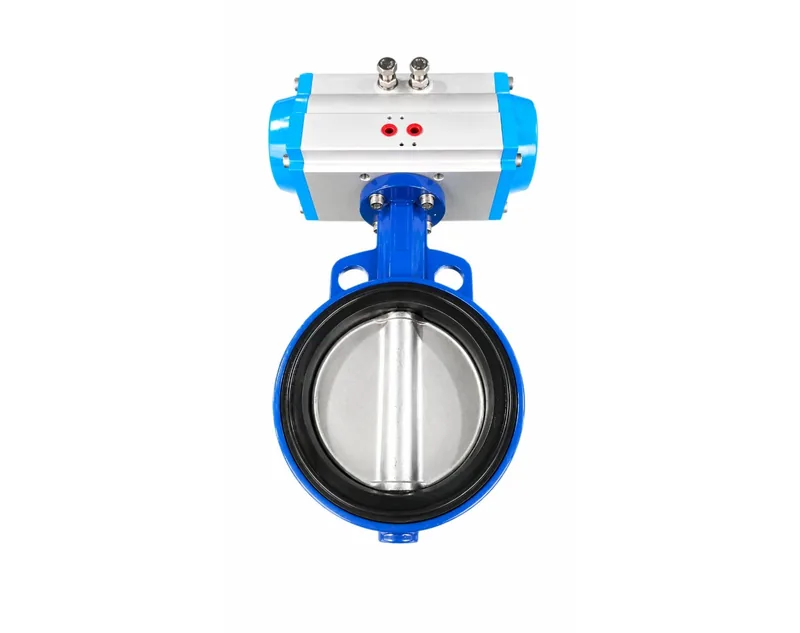
Article Overview: This article provides an analytical comparison of the pneumatic actuator double acting configuration against spring-return alternatives. It offers a decision framework for CTOs, technical architects, and procurement teams evaluating valve automation solutions. Key criteria include operating mode, fail-safe logic, air consumption, torque characteristics, and lifecycle cost.
What Is a Pneumatic Actuator Double Acting?
A pneumatic actuator double acting uses compressed air to both open and close the valve. Unlike single-acting (spring-return) designs, double-acting actuators have no integrated spring mechanism. The valve stem is driven in both directions by differential air pressure on either side of the piston(s).
In rack-and-pinion or scotch-yoke designs, the pneumatic actuator double acting delivers equal torque in both directions (subject to supply pressure and piston area). This makes it suitable for applications where balanced bidirectional force is required and where a power-off position is not mandated by safety logic.
Common configurations include the quarter-turn rotary pneumatic actuator, which is widely used for butterfly and ball valves. Many manufacturers offer modular pneumatic actuator double acting ranges with dual-air ports that can be converted to spring-return by adding a spring module.
How Does a Double Acting Pneumatic Actuator Work?
To understand the operational logic, consider a typical quarter-turn rack-and-pinion actuator. The actuator has two air ports: Port A and Port B, connected to a solenoid valve or control system.
Step 1: Pressurize Port A
Air enters Port A, pushing the pistons outward. The rack rotates the pinion and valve stem clockwise (e.g., to open the valve). Port B is open to exhaust.
Step 2: Pressurize Port B
Air enters Port B, pushing the pistons inward. The pinion rotates counterclockwise (e.g., to close the valve). Port A is open to exhaust. The cycle repeats for each actuation.
Unlike spring-return actuators, which require air only in one direction (to compress the spring), a pneumatic actuator double acting needs continuous air supply to hold the valve at either stroke end. If air pressure is lost, the valve may drift to an undetermined position unless a separate locking device is installed.
This characteristic is critical to the comparison with spring-return designs.
When Should You Specify a Double Acting Pneumatic Actuator?
Selecting a pneumatic actuator double acting depends on the process requirements. Below are typical scenarios where double acting is preferred.
- Fail-last-position logic: If the valve must remain in its current position upon air loss (e.g., for processes that cannot tolerate sudden closure), double acting combined with a lock-up valve or manual override can achieve this.
- High torque demand: Double acting actuators can deliver higher torques than spring-return equivalents of the same frame size because no spring force opposes the air force.
- Constant cycling service: In applications with frequent open/close cycles (e.g., filling lines, blowdown), double acting reduces spring fatigue and maintenance intervals.
- Space-constrained installations: No spring housing means shorter overall length, which may fit into tighter piping arrangements.
Conversely, avoid double acting when safety regulations require fail-safe closure (or opening) upon loss of pneumatic supply. In such cases, a spring-return actuator or a pneumatic actuator double acting with a spring-return module (e.g., a separate spring cartridge) is necessary.
Double Acting vs. Spring-Return: A Decision Framework
To help buyers evaluate trade-offs, we compare the two operating modes across key criteria. The following block cards summarize the main differences.
Fail-Safe Behavior
Option A: Double acting
No inherent fail-safe. Valve position upon air loss depends on friction and process pressure. Often requires an external trip valve or lock-up device to hold last position.
Option B: Spring-return
Built-in fail-safe: spring forces the valve to a predetermined position (open or closed) when air pressure drops below a threshold. Meets safety integrity level (SIL) requirements for many applications.
Buyer note: If your process safety analysis demands a defined fail-state, specify spring-return or a double acting actuator with a spring-return module. Validate against your SIL target and local standards.
Torque Output
Option A: Double acting
Full torque available in both directions. Typically 20–40% higher net torque than the same frame size with spring-return, because no spring resistance is subtracted on the compression stroke.
Option B: Spring-return
Torque output is lower on the spring-compression stroke (usually the return stroke). The available torque for moving the valve is reduced by the spring force. Must oversize if high torque is needed in both directions.
Buyer note: Compare torque curves at your minimum supply pressure. For high-friction valves (e.g., gate valves, choked butterfly valves), double acting may be the only practical choice without excessive oversizing.
Additional comparison criteria include air consumption, cost, and maintenance complexity.
- Air consumption: Double acting uses air for both strokes; spring-return uses air only to overcome the spring. For cyclic processes, double acting may double pneumatic usage.
- Initial cost: Double acting actuators are generally less expensive than spring-return of the same torque class because fewer mechanical parts are required.
- Maintenance: Spring packs can degrade over time. Double acting eliminates spring fatigue but may require more frequent solenoid valve inspection because dual-coil configurations are common.
Key Criteria for Specifying a Pneumatic Actuator Double Acting
When evaluating a pneumatic actuator double acting for your project, use the following checklist to ensure technical fit and avoid field failures.
- Torque margin: Confirm the actuator torque at your minimum working pressure (not at nominal pressure) exceeds the valve breakaway and closing torque, including a safety factor (typically 1.3–1.5).
- Air supply: Verify the pneumatic system provides sufficient volume and pressure for both strokes. Volume flow (Cv) of solenoid valves must match actuator chamber sizes.
- Environmental range: Check temperature limits for seals and lubricants. Double acting actuators often operate in wider temperature ranges than spring-return because spring performance degrades in extreme heat or cold.
- Interface compatibility: Ensure mounting pattern (ISO 5211), coupling dimensions, and port threads align with your valve and accessories. Refer to pneumatic actuator double acting specifications for typical dimensions.
- Accessories: Plan for solenoid valves (single or dual coil), positioners, limit switches, and manual overrides. Many suppliers offer integrated actuator accessory packages that simplify procurement.
These criteria apply across all quarter-turn rotary actuators. Always validate numbers against the supplier’s technical datasheet.
FAQ
Can a pneumatic actuator double acting be converted to spring-return?
Yes, many modular actuators allow insertion of a spring cartridge in the rear end cap. This converts the actuator to spring-return. Conversely, spring cartridges can be removed to convert to double acting. Verify the actuator design and pressure rating before performing any conversion.
What happens if air pressure is lost on a double acting actuator?
Without a locking device, the valve drifts to a position determined by residual pressure, process force, and mechanical friction. This is not a controlled fail-state. Install a lock-up valve or spring-return module if position holding is required.
Is double acting more expensive than spring-return in the long run?
Initial procurement is often lower for double acting because there are fewer spring components. However, operating costs may be higher due to increased compressed air consumption, especially in cyclic applications. Total cost of ownership (TCO) should include energy, maintenance, and accessory costs over the planned service life.
What torque margin should I use for a pneumatic actuator double acting?
A safety factor of 1.3–1.5 is standard for quarter-turn valves. For critical services (e.g., high-temperature, high-viscosity, or particulate-laden media), use 1.5–2.0. Always measure actual valve torque if possible.
Conclusion
Specifying a pneumatic actuator double acting requires a clear understanding of your process safety requirements, torque profile, and pneumatic infrastructure. Double acting offers higher torque and lower initial cost but lacks inherent fail-safe logic. Spring-return provides deterministic failure behavior at the expense of reduced torque and increased mechanical complexity.
Use the decision framework and criteria outlined above to match the actuator mode to your application. For further technical details, refer to the pneumatic actuator double acting product page to explore configurations and accessories. Always consult your supplier’s engineering team to validate fit for your specific valve and process conditions.