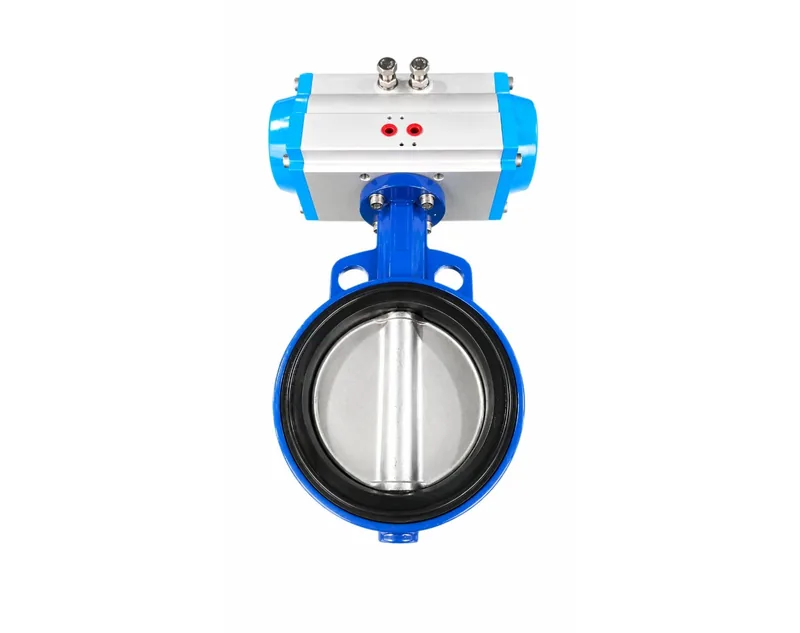
Article Overview: This article gives process engineers, technical buyers, and evaluation committees a structure for comparing a limit switch box with a positioner as feedback options for pneumatic actuators. It answers whether discrete open/closed status is enough, confirms that a limit switch box cannot provide modulating feedback, and compares mechanical versus proximity sensing. The conclusion is that the control command, not the accessory catalog, should drive the choice. Product claims are bounded by the supplied actuator-accessory documentation, so validate electrical and mechanical values against your own valve and control-system datasheets.
What Is the Difference Between a Limit Switch Box and a Positioner?
A limit switch box reports open/closed end positions, while a positioner moves the actuator toward a commanded setpoint. Limit switch boxes support state confirmation; positioners support continuous position control, so they are not interchangeable ways to deliver feedback.
The useful distinction is control-loop responsibility. A limit switch box is a passive detector: when the actuator reaches an open or closed travel stop, the contacts or sensors inside the box change state. The box does not move the actuator. A positioner is an active regulator: it receives a desired position, compares that with the actual shaft position, and changes air pressure until the valve reaches the setpoint. For this reason, a positioner belongs in modulating service, while a limit switch box is enough for simple end-point confirmation.
Supplier catalogs do not always separate the terms clearly. The overview of Common accessories used with pneumatic actuators lists limit switches under signal accessories and treats a positioning transmitter separately for analog control feedback. Use that distinction when writing your control narrative: end-position detection, modulating control, and analog position feedback are three different requirements.
How Should an Evaluation Committee Compare Feedback Options?
Evaluate the signal the controller actually needs, the actuator duty, and the commissioning effort each option creates. A binary open/closed proof points to a limit switch box; an analog setpoint that must be tracked points to a positioner.
Start with command type. If the DCS or PLC writes only open and close commands through a solenoid valve, discrete status inputs from a limit switch box will satisfy the interlock and monitoring logic. If the controller writes a setpoint and expects the valve to hold an intermediate position, a positioner is doing control work rather than feedback work.
The same logic appears in the essential pneumatic actuator accessories guide: each accessory maps to a control function. Avoid choosing accessories by accumulating options.
Before comparing vendors, complete one functional requirement sentence: "The controller needs ___ whenever the valve is ___." If that sentence can be completed with "a status input" and "fully open or fully closed," the specification ends at a limit switch box. If it needs "an analog setpoint" and "held at a partial position," the specification must include a positioner. This wording prevents procurement teams from substituting a feedback transmitter for a control device.
| Criterion | Limit switch box | Positioner |
|---|---|---|
| Role in the control loop | End-position sensor | Setpoint-following controller |
| Information delivered | Discrete contact state at open/closed travel stops | Actual position adjusted to match a commanded setpoint |
| Effect on actuator motion | None by itself; a solenoid valve switches the air supply | Regulates air pressure to move the valve toward the setpoint |
| Typical valve service | On/off isolation, routing, interlock proof | Throttling or other modulating processes |
| Commissioning focus | Adjusting cams or sensors at the end positions | Calibrating travel, input range, and control-loop behavior |
Decision workflow for the evaluation committee
Step 1 - Classify actuator duty: Distinguish on/off isolation from throttling or blending.
Step 2 - Define the signal each option must return: A limit switch box returns discrete logic; a positioner produces continuous positioning.
Step 3 - Check electrical and installation constraints: Confirm voltage, contact rating or sensor output, cable entry, and mounting interface.
Step 4 - Compare support burden: Count the calibration, spare-part, and troubleshooting tasks associated with each accessory.
Do I Need a Positioner if I Only Need Open and Closed Signals?
No. If the control system only requires proof that the valve is fully open or fully closed, a limit switch box is sufficient. A positioner adds continuous positioning functions that a binary on/off loop will not use.
Start with the command type already defined in your control narrative. On/off valves normally receive a binary command through a solenoid valve, and the limit switch box confirms that the actuator reached the commanded end position. The controller does not ask the valve to stop at an intermediate angle, so closed-loop position control is not required.
Signs that a limit switch box is sufficient:
- The control system has only digital open/closed status inputs.
- The valve duty is isolation, routing, or interlock proof rather than flow modulation.
- The signal chain is solenoid valve plus actuator, with no analog setpoint from the process controller.
Procurement context can change this answer. For example, if the plant already standardizes on positioners for adjacent modulating valves, using one on an on/off valve may reduce spare-part variety. Treat that as a commercial trade-off, not as a feedback requirement.
Can a Limit Switch Box Provide Modulating Feedback?
No. A limit switch box is an end-position sensing accessory. It can confirm open or closed states, but it cannot measure intermediate stem positions or issue the proportional feedback signal that a modulating controller needs.
Modulating feedback, as used here, is a signal that changes with actuator position so the controller can infer intermediate travel. A conventional limit switch box changes state only when the actuator reaches a set position; between those points, no signal varies. It therefore cannot act as an analog position transmitter for a throttling loop. Continuous position feedback is normally supplied by a positioner with a feedback element or by a dedicated transmitter that converts actuator position into a 4-20 mA or 0-10 V signal.
The supplied actuator-accessory documentation separates open/close detection from a transmitter for positioning, reinforcing the same conclusion. If your process asks only for end-state proof, the limit switch box covers it. If a controller expects a proportional reading, specify the transmitter or positioner instead of relying on the switch box.
Should I Choose Mechanical Limit Switches or Proximity Sensors in a Limit Switch Box?
Choose mechanical contacts for low-cycle installations where technicians want simple, visible wiring; consider magnetic or proximity sensors for high-cycle service where contact wear matters. Confirm supply voltage and output wiring against the PLC/DCS input card before deciding.
A mechanical limit switch makes or breaks a circuit when the actuator cam presses a lever, roller, or plunger. Its operation is easy to inspect with a meter, but the moving parts and electrical contacts have a practical service life related to the number of operations and the switched load. A proximity or magnetic sensor detects a target without striking it; both sensing methods are named in the supplier material for open/close position detection. Non-contact sensing removes cam-contact wear, but the electronics require a stable power supply, correct output type, and a compatible controller input.
Base the choice on cycle rate, ambient dust and moisture, electrical compatibility, and maintenance skill rather than on a general preference. If the actuator family is still being selected, actuator construction affects the mounting surface and vibration environment for the switch box. Review the comparison of heavy-duty pneumatic actuators and rack-and-pinion pneumatic actuators before finalizing the mechanical package.
FAQ
Does a positioner give the same open/closed proof as a limit switch box?
No, not in the same signal form. A positioner's normal output is pneumatic and is used to move the actuator, so it is not a simple digital status transmitter. If the control system needs an independent open/closed proof, a limit switch box is usually the more direct signal source because its contacts indicate the travel stops.
Can a limit switch box and a positioner be mounted on the same actuator?
Yes, in automated valve packages they can serve separate functions: the positioner follows the modulating command, and the limit switch box supplies discrete end-position signals for interlocks and monitoring. Check physical clearance, mounting interface, and wiring layout before ordering, because both accessories often share the same top or side mounting pad.
Does a faster actuator make proximity sensors mandatory?
Not automatically, but high cycle rates increase the number of operations that mechanical contacts experience, so magnetic or proximity sensors are often proposed for that duty. Confirm sensor supply voltage and output type match the input card; operating speed alone does not determine the sensing technology.
Conclusion: Let the Control Command Decide
Use a limit switch box when the controller needs discrete proof that an on/off valve reached its end position. Use a positioner when the controller requires continuous positioning of the valve. A limit switch box cannot supply the proportional feedback or closed-loop adjustment that modulating service needs. Define the signal path and duty first, verify the electrical environment, and then select the feedback package with supplier datasheets.