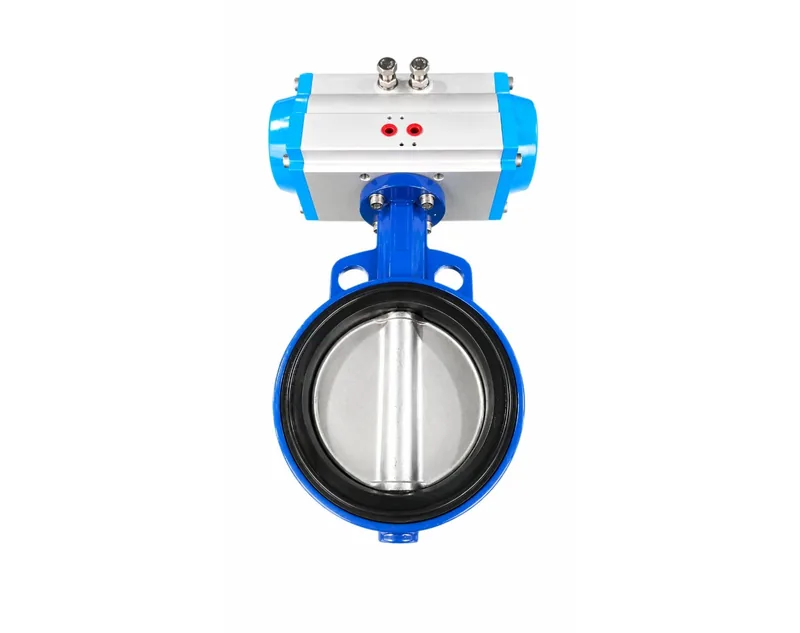
How does a pneumatic rotary actuator work?
A pneumatic rotary actuator is a device that transforms compressed air energy into mechanical motion. It is an essential element in industrial automation, frequently employed to control valves, clamps, and various other apparatus. Its functionality is based on a straightforward yet efficient principle: employing differential air pressure to generate linear or rotational force.
The most prevalent type is the piston-style actuator. It comprises a cylinder, a piston, a piston rod, and air supply apertures. To commence movement, compressed air is supplied into one side of the cylinder via an inlet valve. This injected air, generally at pressures ranging from 40 to 120 psi, exerts a force on the surface area of the piston.
Since the piston is enclosed within the cylinder, this pressure differential compels it to advance linearly, extending the piston rod. This is the "push" stroke. To retract the rod, the procedure is inverted: the initial chamber is vented or exhausted, while compressed air is introduced into the opposite side of the piston, driving it and the rod back to their initial position. This produces the "pull" stroke.
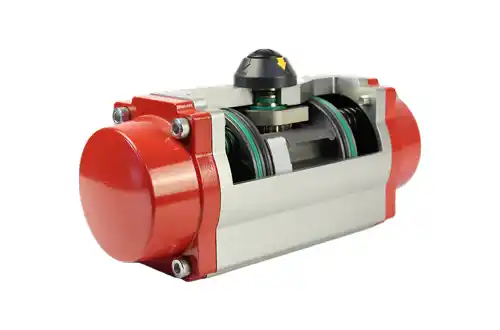
The direction of this airflow is meticulously regulated by an independent valve, referred to as a solenoid or control valve, which functions as the switch. For tasks necessitating a quarter-turn, such as operating a ball valve, a rack-and-pinion mechanism is commonly employed, wherein a toothed piston (the rack) engages with a small gear (the pinion) to convert linear force into a 90-degree rotational motion.
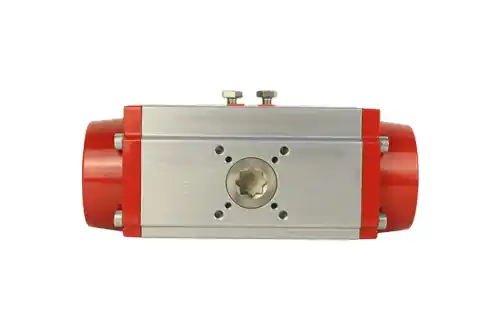
Essentially, a pneumatic rotary actuator functions as a robust and dependable muscle. Its simplicity, swift responsiveness, and inherent safety in hazardous environments—due to its non-sparking nature—render it a fundamental technology for regulating numerous industrial processes.