Article Overview: This article provides a technical comparison of the key components influencing sealing performance in packaging film machines, specifically pneumatic actuators, limit switch boxes, and gearboxes. It offers a buyer-side decision framework for CTOs, technical architects, and procurement teams to evaluate options objectively, highlighting tradeoffs, fit criteria, and operating implications. The focus is on helping readers choose the right combination of actuation and feedback solutions for their specific sealing application.
Introduction: The Critical Role of Sealing in Packaging Film Machines
In packaging film machines, the sealing unit is often the most performance-sensitive subassembly. Consistent seal quality directly impacts product integrity, packaging speed, material waste, and overall line efficiency. The sealing process typically involves a combination of heat, pressure, and timing, all of which are regulated by pneumatic actuators and monitored by position feedback devices. Selecting the wrong actuator or limit switch can lead to inconsistent seals, increased downtime, or even safety hazards in explosive environments. This article compares the main types of pneumatic actuators and limit switch boxes used in sealing applications, along with gearbox options for manual override, providing a structured evaluation framework for procurement and engineering teams.
1. Pneumatic Actuators: Single Acting vs. Double Acting for Seal Pressure Control
The pneumatic actuator is the muscle behind the sealing jaw. It controls the pressure applied to the film layers during the sealing dwell time. The two primary working modes for pneumatic air solenoid valves—single acting and double acting—directly affect actuator behavior and system design.
Single Acting Actuators
Single acting actuators use spring return to a default position (usually retracted) and require air pressure to extend (or vice versa). They are inherently fail-safe: if air supply is lost, the spring returns the actuator to the safe position. For sealing, this means the jaws will open automatically if pressure drops, preventing film burn-through or jams. However, the spring force limits the maximum sealing pressure and can cause a gradual pressure drop during the seal cycle as the spring compresses. This mode is suitable for low to moderate sealing speeds where consistent pressure is less critical than safety.
Double Acting Actuators
Double acting actuators use air pressure for both extension and retraction, allowing precise control of sealing force and speed in both directions. They can deliver higher and more consistent pressure throughout the stroke, which is advantageous for high-speed packaging lines or films requiring elevated sealing pressures. The tradeoff is that they are not fail-safe: loss of air pressure leaves the actuator in its last position, potentially causing a stuck jaw or incomplete seal. Double acting designs also require more complex valve control and additional air consumption.
Evaluation Criterion: For sealing applications, consider the required sealing force, cycle speed, and safety requirements. Single acting is preferable when fail-safe open is mandatory (e.g., heat-sensitive films). Double acting suits high-speed, high-force applications where positional control and pressure consistency are paramount.
Related internal link: Learn more about our pneumatic actuator product line.
2. Limit Switch Boxes: Position Feedback for Sealing Timing and Quality
Accurate position feedback is essential for controlling the seal dwell time and jaw position. Limit switch boxes, such as the APL-210N and the ITS-300 explosion-proof models, provide remote confirmation that the actuator has reached the sealed or retracted position. These signals are typically used in conjunction with the PLC to synchronize sealing, cooling, and film advance.
Standard vs. Explosion-Proof Limit Switch Boxes
The APL-210N limit switch box is a widely used industrial solution that includes a visual position indicator, quick-set cams, a terminal strip, and an easy-to-mount bracket. It is suitable for most packaging environments where dust and moisture are controlled. The ITS-300 explosion-proof limit switch box, on the other hand, is designed for hazardous locations where flammable gases or combustible dusts may be present (e.g., packaging of volatile materials). It offers the same remote signaling capability but with robust, sealed enclosures to prevent ignition.
Tradeoffs:
- Cost and Complexity: Explosion-proof units are significantly more expensive and heavier. For non-hazardous environments, standard boxes like the APL-210N provide reliable performance at lower cost.
- Setup Flexibility: Both models offer quick-set cams for easy adjustment of switch actuation points. However, explosion-proof designs may have more constrained cam travel ranges due to enclosure limitations.
- Long-Term Reliability: In clean packaging lines, standard boxes perform well. In areas with vibration or extreme temperatures, explosion-proof boxes often offer better sealing and durability, even if not strictly required.
Decision Point: Evaluate the classification of the packaging area. If sealing is performed in a non-hazardous, clean environment, a standard limit switch box is likely sufficient. For any explosion risk, choose certified explosion-proof units. Also consider the actuator type: double acting actuators benefit from dual feedback (extend and retract), while single acting may only require feedback on the sealed position.
Related internal link: See our actuator accessory range including limit switch boxes.
3. Gearboxes: Manual Override and Torque Multiplication for Sealing Mechanisms
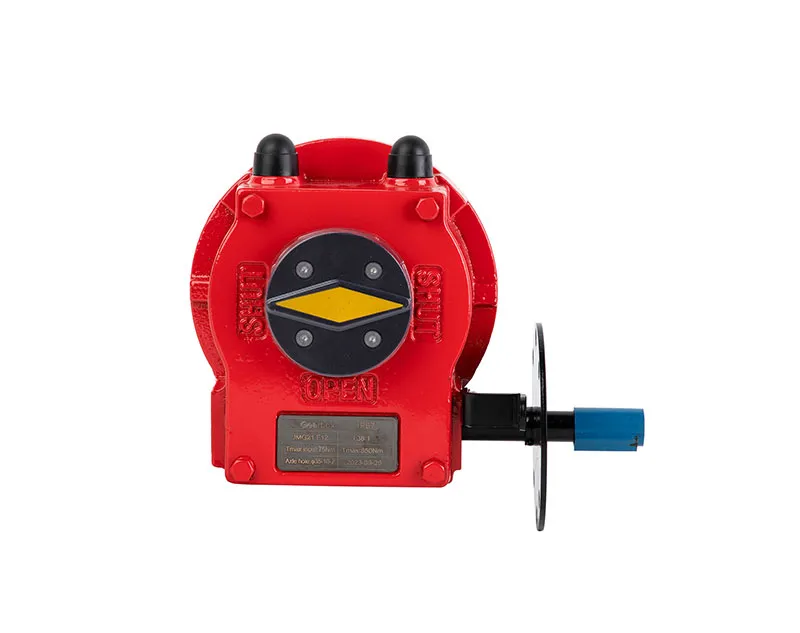
In many packaging film machines, especially those operating at high speeds or handling heavy sealing jaws, a gearbox may be used to connect a pneumatic actuator to the sealing mechanism. Gearboxes provide torque multiplication and allow for manual override during setup, maintenance, or power loss. Two common types are bevel gearboxes and declutchable gearboxes.
Bevel Gearboxes
Bevel gearboxes (e.g., BA Series multi-turn bevel gearbox) offer a compact, right-angle drive that changes the direction of rotation. In sealing applications, they are used to transfer rotary motion from an actuator to a linear sealing jaw via a cam or linkage. They provide smooth torque transmission and are often chosen for their high efficiency and low backlash. However, they do not include a disengagement mechanism; if the actuator fails, the manual override requires turning the actuator shaft directly, which may be difficult.
Declutchable Gearboxes
Declutchable gearboxes (e.g., SD Series) are specifically designed for manual override. They include a clutch that disengages the actuator, allowing the operator to manually drive the sealing mechanism without back-driving the actuator. This is critical for emergency manual operation, such as clearing a film jam or performing precise adjustments during setup. The tradeoff is that declutchable gearboxes are more expensive and have a slightly larger footprint than standard bevel gearboxes of similar torque rating.
Selection Criteria:
- If manual operation is only needed infrequently for maintenance, a standard bevel gearbox with a manual handwheel may suffice.
- If rapid, safe manual override is required for safety or quick changeovers, a declutchable gearbox is a better investment.
- Consider space constraints: bevel gearboxes are generally more compact than declutchable units for the same torque.
Related internal links: Explore our bevel gearbox and declutchable gearbox options.
4. Decision Framework for Procurement and Specification
When evaluating sealing performance in packaging film machines, a structured comparison helps avoid costly mismatches. Below is a framework organized by evaluation criteria:
| Criterion | Questions to Ask | Impact on Choice |
|---|---|---|
| Sealing Force & Cycle Speed | What is the required seal pressure and cycle time? Is the packaging line high-speed or variable-speed? | Double acting actuators for high force/speed; single acting for lower demands. |
| Safety & Fail-Safe Requirements | What happens on air loss? Must jaws open automatically to prevent film damage or fire? | Single acting with spring return preferred; double acting requires additional safety valve or mechanical backup. |
| Environmental Conditions | Is the sealing area classified for explosion risk? Presence of dust, moisture, or corrosive gases? | Standard vs. explosion-proof limit switch boxes; material selection for actuators (e.g., stainless steel). |
| Maintenance & Manual Override | How often will manual intervention be needed? Is quick jam clearance critical? | Declutchable gearbox if frequent manual override; bevel gearbox for less frequent use. |
| Integration with Control System | What feedback signal type is required (mechanical switch, proximity, or analog)? | Limit switch boxes with adjustable cams for on/off feedback; consider positioners if analog feedback needed. |
| Total Cost of Ownership | Compare initial cost vs. maintenance, downtime, and energy consumption over machine lifetime. | Balance capital expenditure with reliability; explosion-proof and declutchable components have higher upfront cost but may reduce downtime. |
Use this table to map your specific application constraints to the appropriate component combination. For example, a food packaging line for sensitive products might prioritize single-acting actuators with explosion-proof limit switches and a declutchable gearbox for quick cleaning.
Related internal link: For application-specific guidance, visit our Application Center.
Frequently Asked Questions
What is the expected lifespan of a pneumatic actuator in a continuous packaging film machine?
Lifespan depends on cycle rate, air quality, and seal material. High-quality pneumatic actuators can exceed 5 million cycles if properly maintained. Using filtered, lubricated air and avoiding overloading the actuator will extend life.
Can I use a standard limit switch box in a dust-laden packaging environment?
Standard boxes like the APL-210N are suitable for general industrial dust, but for fine conductive dust or flour, an explosion-proof model may be required by safety codes. Check local regulations and machine directive.
Is a declutchable gearbox necessary for all packaging film sealers?
No. Manual override is only needed if the sealing mechanism must be repositioned frequently or if power loss jams occur frequently. Many machines use a simple bevel gearbox with a handwheel, relying on the actuator’s manual override screw for rare adjustments.
What is the main difference between single-acting and double-acting actuators for sealing?
Single-acting uses a spring return, providing fail-safe open but limited force. Double-acting uses air both ways, offering higher, more consistent force but no inherent fail-safe. The choice depends on sealing pressure requirements and safety needs.
How do I select the right limit switch cam arrangement?
Set the cams so that the extend switch actuates just after the sealing jaw contacts the film, and the retract switch actuates just after full retraction. This minimizes cycle time and ensures proper dwell. Quick-set cams make adjustment straightforward.
Conclusion
Sealing performance in packaging film machines is a multi-variable challenge that demands careful component selection. By comparing pneumatic actuators (single vs. double acting), limit switch boxes (standard vs. explosion-proof), and gearboxes (bevel vs. declutchable), buyers can tailor their machine design to specific speed, safety, and environmental requirements. No single solution fits all; the optimal combination depends on a clear understanding of the sealing process constraints and operating context. Use the decision framework provided to structure your evaluation, and always validate component specifications with real-world testing. Ultimately, investing in the right actuation and feedback system pays off through reduced waste, higher uptime, and consistent package quality.
For further exploration of related components, browse our product range or contact us for application engineering support.